
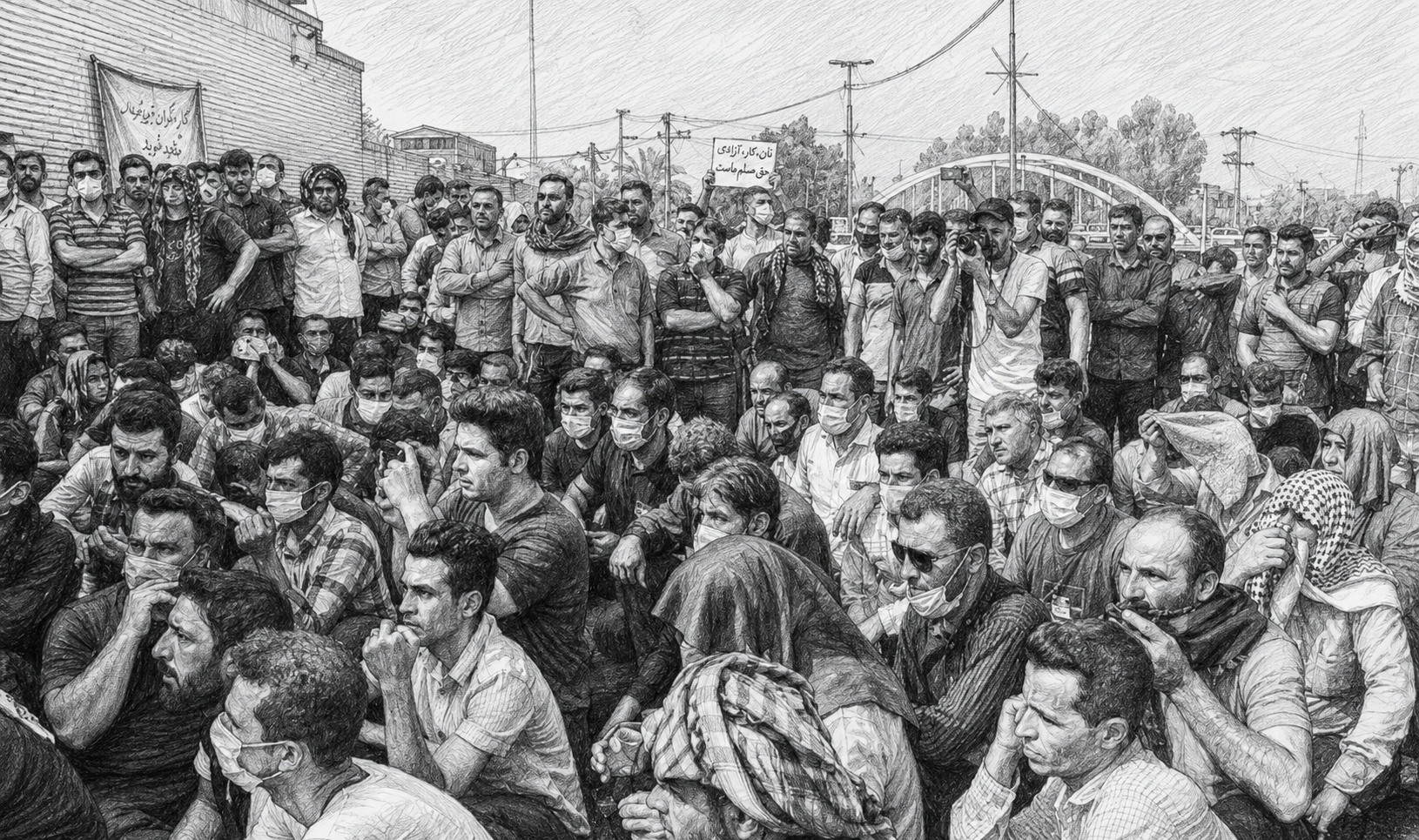
The draft bill on “Creating a New Social Security System” would reduce employers’ insurance contribution from 23 percent to 7 percent. In practice, it would remove a major burden from employers and shift it onto the public budget, social insurance funds, and the future of workers. At the same time, the suspension and cancellation of contracts for eight petrochemical workers in Mahshahr, after they pursued their legal claims, shows that pressure on labor is not limited to legislation. It is also taking place inside workplaces, through temporary contracts and direct threats to job security.
Lower Employer Contributions, Greater Pressure on the Funds
The draft bill on “Creating a New Social Security System” was prepared by the Ministry of Cooperatives, Labor and Social Welfare. According to published reports, it is expected to go to parliament after approval by the cabinet. Its declared aims are “reforming social security,” “reducing production costs,” and “increasing incentives to hire workers.” But its most important provision, reducing employers’ insurance contribution from 23 percent to 7 percent, is far more than an administrative change.
Under this plan, the remaining 16 percent would have to be covered through public resources or taxation. In practice, part of the cost currently paid by employers would be lifted from capital and transferred to the public budget, society, and ultimately wage earners themselves.
This shift is being proposed at a time when pension and insurance funds are already under pressure from accumulated government debt, repeated withdrawals, unfunded obligations, and liquidity problems. If the reduction in employers’ contributions is implemented without a stable and collectible source of replacement funding, it could deepen the crisis of these funds and make social security even more hostage to the government’s budget deficit.
Social Security Is Not State Property
The Social Security Organization is legally a public, non-governmental institution. Its assets do not belong to the state. These resources have been built through the insurance contributions of workers, retirees, and insured people. They have a fiduciary and intergenerational character. A worker who pays insurance contributions for years is setting aside part of today’s wage for tomorrow’s security.
The new bill, according to its critics, weakens this boundary. When social insurance resources and obligations are brought closer to the public budget, the institutional independence of social security is eroded. A fund that should protect insured workers and retirees is pushed closer to becoming part of the government’s financial machinery.
The central question is clear: can the state use resources built from years of workers’ and retirees’ insurance payments to reduce employers’ costs and manage today’s fiscal crises?
This is not just a technical question. It concerns the relationship between the state and workers. Over the past years, the government has repeatedly spent from the funds, created obligations, accumulated debt, and failed to repay it on time. Now the same government is supposed to take over part of the employers’ contribution. If the funds have not been able to recover their previous claims from the state, how are they supposed to collect this new 16 percent from the government or the Ministry of Economic Affairs?
Cheap Labor for a Possible Economic Opening
The plan to reduce employers’ insurance contributions is not being discussed in a vacuum. It is moving forward at a time when the possibility of an agreement between Iran and the United States, and the reopening of some economic channels, has once again entered Iran’s political debate. If such an opening leads to foreign investment or increased domestic investment, the state must make clear what kind of labor market it is preparing for capital.
The existing signs are alarming: cheap labor, fragile contracts, no independent unions, controlled labor protests, and lower costs for employers.
In recent years, the cheapness of labor in Iran has often been blamed on sanctions, economic crisis, or external pressure. But the structure of Iran’s labor market shows that the cheapening of labor is, above all, the result of domestic policy. Minimum wages below the poverty line, the spread of temporary contracts, contracting companies, repression of strikes, and restrictions on independent worker organization are all parts of this policy.
Reducing employers’ insurance contribution completes this chain. The worker not only lacks a sufficient wage and job security, but also sees the insurance and pension protection built from their own labor placed at risk by a policy whose main goal is to reduce the cost of capital.
Mahshahr: The Cost of Pursuing Legal Rights
At the same time that details of the new social security bill were being published, reports also emerged about the suspension and cancellation of contracts for several petrochemical workers in Mahshahr. According to these reports, 48 contract workers at Mahshahr Petrochemical Terminals and Tanks Company had filed complaints through official channels to receive their legal entitlements.
After part of their claims was paid through legal authorities, eight workers who had been active in the complaints faced suspension and cancellation of their future contracts. The workers’ question is direct: can pursuing legal rights be used as a pretext to end cooperation with a worker?
The importance of this case is not limited to the numbers eight or 48. It shows that in many workplaces, even using legal channels is not without cost for workers. A worker may recover part of their rights through a complaint, but then lose their future contract. In such a structure, the law alone does not protect the worker, because there is no job security or collective power to defend it.
Mahshahr offers a compressed image of a much wider situation in the oil, gas, petrochemical, and contracting sectors. Contract and temporary workers are constantly dependent on contract renewal. This puts them in a position where even demanding their legal rights can carry the risk of unemployment.
The Chain of Stripping Labor Rights
The social security bill and the Mahshahr case are not separate issues. They both point to the same logic: reducing the cost of capital by weakening the position of workers.
At the legal level, the employer’s contribution is reduced and the financial burden is transferred to the public budget and social funds. At the workplace level, a worker who makes a legal claim faces suspension or exclusion from future contracts. One targets the worker’s social protection. The other targets their job security.
Iran’s labor market has already been organized around the weakening of labor. The absence of independent unions, the spread of temporary contracts, intermediary companies, low wages, security pressure on protests, and restrictions on the right to strike have reduced workers’ bargaining power to a minimum.
In this structure, reducing employers’ insurance contributions is not an isolated measure. It continues the same process that keeps the cost of labor low and transfers its social costs into the future. Instead of strengthening job security, wages, and the right to organize, the state reduces employers’ costs. Instead of financing support for production through taxes on wealth, profit, rent, and capital, it turns toward social insurance resources.
Using the Assets of the Future for Today’s Crisis
The crisis of social security in Iran is not an accounting crisis. It is about the relationship between the state, workers, and retirees. Social security resources are the product of years of labor and insurance payments. These resources were meant to protect the lives of insured people today and tomorrow, not to serve as an emergency fund for short-term state policies and budget gaps.
Reducing employers’ insurance contributions transfers today’s costs into the future. The government makes a decision today to reduce the cost of capital, but its consequences may appear in the coming years as pressure on pensions, reduced services, accumulated debt, and the erosion of the funds.
In this process, the worker pays twice. First in the workplace, through low wages, temporary contracts, and the risk of dismissal. Then again in the social security system, through the weakening of the very protection built from their own wages.
The labor market being prepared through these policies is not a free labor market. It is a cheap and controlled labor market. In such a market, capital enters at a lower cost, the state protects employers, social funds come under pressure, and workers must worry about their future contracts even when they pursue their legal rights.
Editorial Board of Iran Labor Echo


