
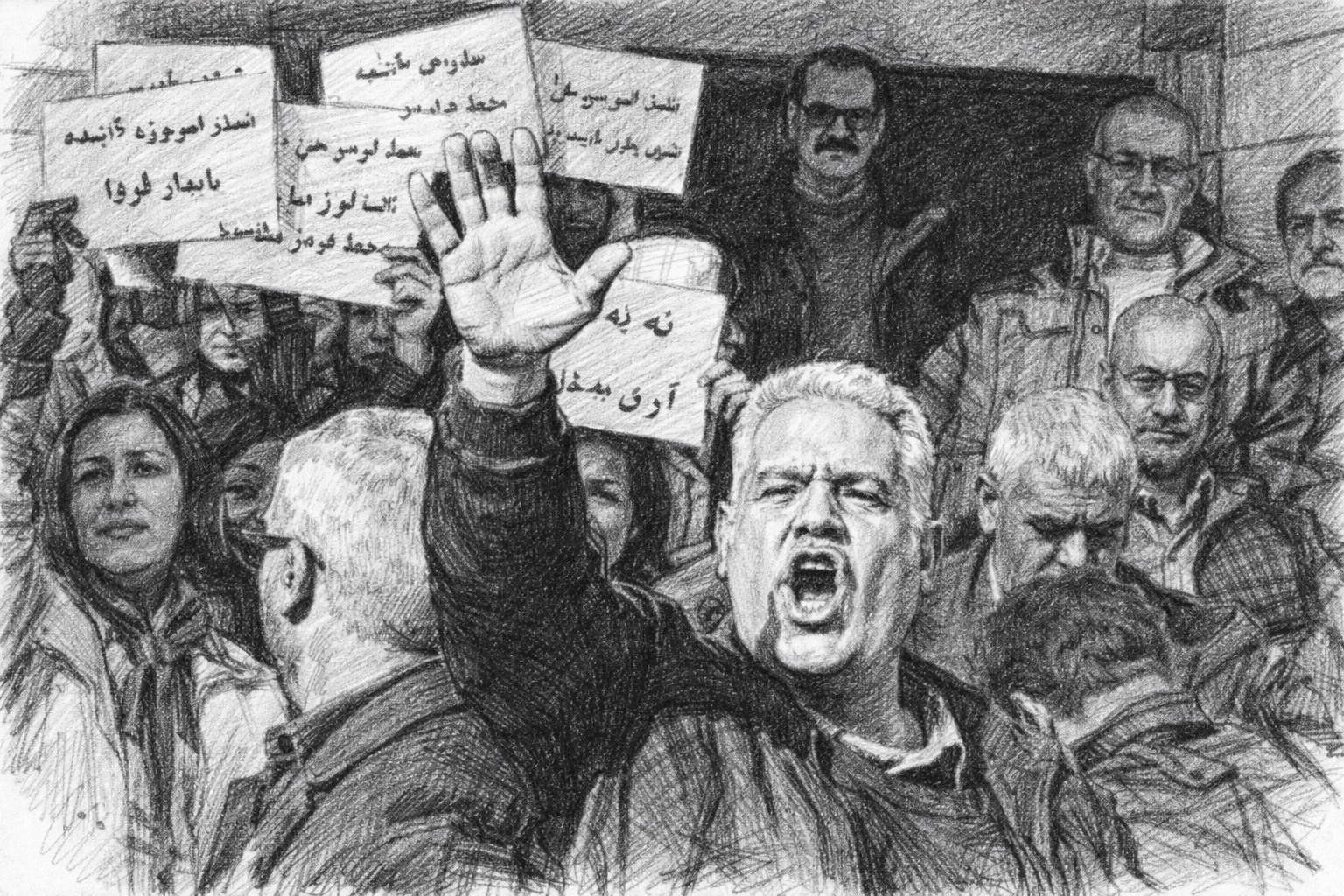
At the beginning of the Iranian year 1405, one of the country’s most important economic and social issues was the setting and announcement of the minimum wage for workers. This wage is not simply a number in official tables. It forms the material basis of life for millions of workers and their families. Yet the process of setting and announcing this year’s wage once again showed that wages in Iran are not merely an administrative matter. They are a battlefield between the interests of labour and the dominant logic of the country’s political economy.
In the final days of 1404, the Supreme Labour Council approved a wage increase for 1405. But what happened afterwards showed that even after formal approval, the fate of workers’ wages remained exposed to backroom bargaining, economic pressure, and political calculations.
Delayed Announcement, Wage Uncertainty at the Start of the Year
Although the wage increase was approved at the end of the year, its official announcement was delayed until the first weeks of the new year. During this period, different dates were mentioned for the formal release of the decision, but each time the promise went nowhere. This created a state of wage uncertainty for millions of workers who, under high inflation and severe pressure from living costs, were waiting to know what their income would be in the new year.
The direct consequence of this delay became clear in the payment of Farvardin wages. Many employers, using the absence of the official circular as justification, paid workers according to the previous year’s wage level. In practice, workers spent the first month of the year on last year’s wages, while the cost of living had already begun rising from the very start of the year.
A proposal to pay wages on an interim basis could have reduced this pressure to some extent, but it was rejected by sections of employers. Once again, it became clear that under the current labour market structure, even the gap between approval and official announcement can be used to suspend wages in practice.
Finally, in late Farvardin, the circular setting the minimum wage for 1405 was issued. But the long and unclear process of issuing it was itself a sign of the bargaining behind the scenes over wages and the attempt to control their level.
The 1405 Minimum Wage: A Numerical Increase Against the Reality of Survival
According to the issued circular, the daily minimum wage for workers in 1405 was set at 5,541,850 rials. For other wage levels, a 45 percent increase was approved, along with a fixed additional amount. Benefits such as household goods allowances, seniority pay, and marriage allowance were also included in the decision.
On the surface, these increases may look like an attempt to compensate for part of the pressure on workers’ livelihoods. But the reality of working-class life tells a different story. In a situation where chronic inflation has sharply reduced the purchasing power of wage-earners over recent years, even relatively high percentage increases do not necessarily mean a real improvement in living standards.
For a large section of workers, wages are not simply income. They mark the line between survival and the economic collapse of the household. The rising costs of housing, food, transport, healthcare, and education have widened the gap between wages and the real cost of living to an unprecedented level.
In these conditions, the wage question cannot be understood only through the percentage of increase. What matters is the relationship between wages and the real cost of reproducing workers’ lives. In Iran’s economy, this relationship has continuously shifted against labour in recent years.
Hidden Mechanisms of Wage Control
The wage circular does not only set wage figures. It also includes clauses and mechanisms that show wage control is not carried out only through the official minimum wage.
The circular allows wage increases in some economic units affected by wartime conditions to be determined through workplace-level agreements. On paper, this can be justified as a way to preserve jobs or support struggling businesses. In practice, however, it can become a tool for reducing real wages. In workplaces facing economic crisis, the balance of power between workers and employers is usually deeply unequal. Workers are often forced to accept lower wage conditions simply to keep their jobs.
The emphasis on wage increases through workplace agreements and collective contracts is also being raised in a labour market marked by weak job security, widespread temporary contracts, and limited bargaining power for workers. In such a context, these agreements often become a way to manage labour costs, rather than a mechanism for real wage improvement.
At the same time, excluding some groups of temporary workers from wage regulations is another sign of the expansion of a flexible and cheap labour market. This trend gradually narrows the boundaries of legal protection for workers.
The Political Economy of Wages: Why Wages Always Fall Behind
To understand the wage question in Iran, we have to place it within the framework of political economy. In this framework, wages are not just an economic variable. They are part of the power relation between labour and the ruling economic structure.
In an economy facing chronic inflation, structural crisis, falling productive investment, and political and external pressures, one of the easiest ways to control costs is to keep wages low. In other words, part of the burden of economic crisis is placed directly on the shoulders of workers.
Even when wage increases are announced, they usually remain far behind the rising cost of living. This is why the gap between wages and living costs has continued to grow over recent years.
From this perspective, wages in Iran are not only a means of sustaining workers’ lives. They are also one of the main tools used to manage economic crisis.
Workers’ Livelihoods: Life on the Edge of Survival
For millions of workers and wage-earners, wages are the main source of survival. But with the constant fall in purchasing power, many working-class families have been forced to rely on different survival strategies: taking multiple jobs, working long overtime hours, cutting back on essential goods, or falling into debt and borrowing.
In such conditions, any delay in setting or paying wages can have direct and immediate consequences for everyday life. The wage uncertainty at the start of 1405 should be understood in this light. It once again showed how vulnerable workers’ livelihoods are to administrative decisions and political calculations.
Wages Are More Than a Circular
What we saw in the process of setting and announcing the 1405 wage was not simply an administrative dispute or a bureaucratic delay. It reflected a wider struggle over income distribution in Iran’s economy.
On one side of this struggle stand millions of workers and wage-earners whose lives depend on wages. On the other side stands an economic structure that seeks to keep the cost of labour as low as possible.
In such conditions, the wage question is not merely a trade-union issue. It is directly tied to economic justice, the distribution of wealth, and the position of labour within the economy.
A wage increase may reduce part of the pressure on workers’ lives. But as long as the gap between wages and the real cost of living remains, workers’ livelihoods will continue to be one of the most urgent social and economic questions in Iran.


