
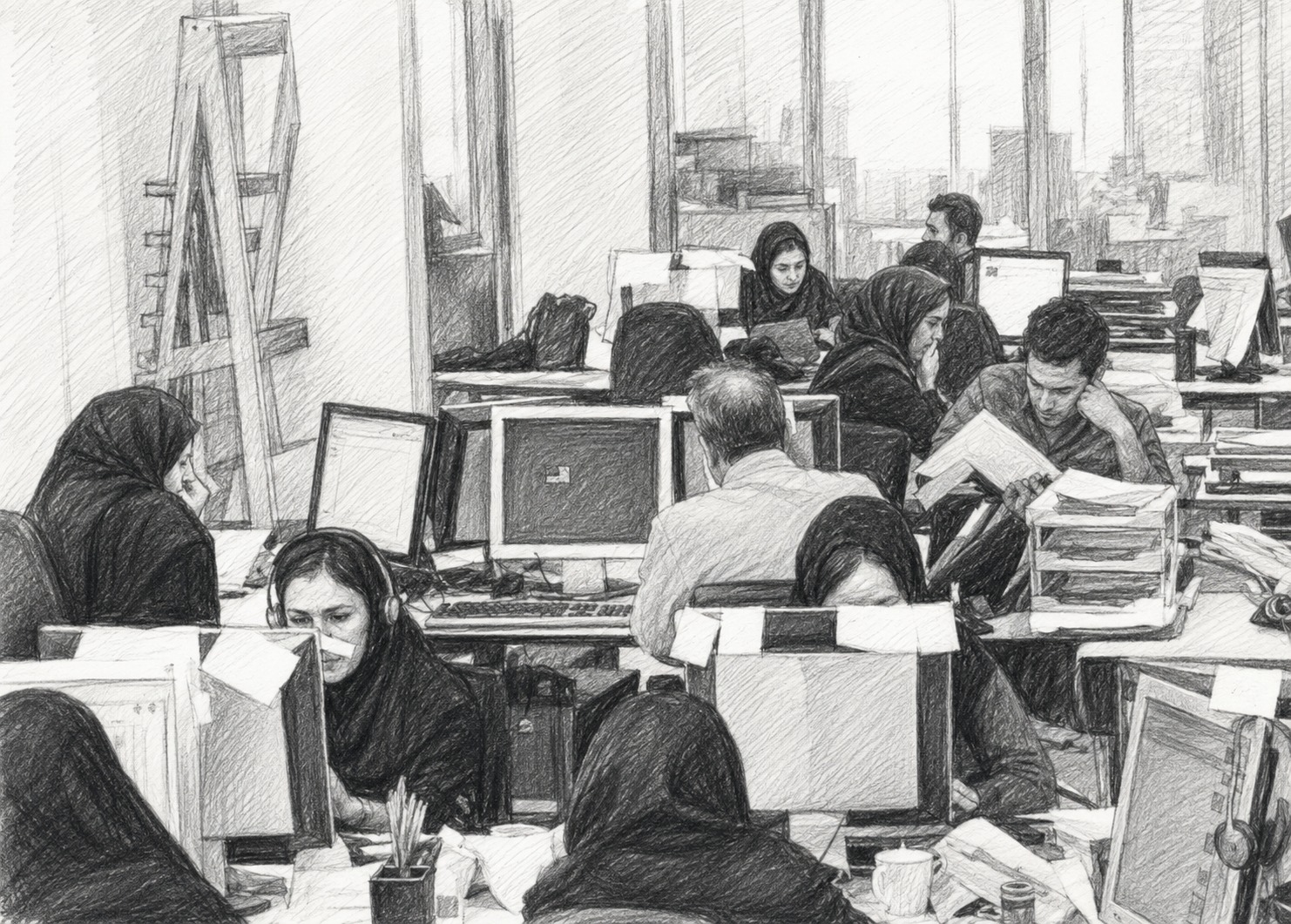
Reports published in recent days, despite heavy media restrictions, censorship, self-censorship, and the removal of a large part of the reality on the ground, show a clear picture of a deep crisis in Iran’s labor market: falling purchasing power, suspension and dismissal of workers, unpaid wages, delayed or suspended insurance payments, unstable contracts, pressure on retirees, and a growing need for unemployment insurance.
This picture is not complete. A large part of dismissals, factory shutdowns, labor protests, workplace accidents, and insurance cuts never appears in official media. Still, even the small part that is published through licensed media shows that the labor crisis in Iran has gone far beyond a simple “cost of living problem.” It has become a crisis in the ability of workers and their families to reproduce their daily lives.
At the center of this situation is the gap between wages and the cost of living. A published estimate of the basic cost-of-living basket shows that the figure calculated during wage negotiations at around 45 million tomans — roughly $256 — rose in less than two months to 71.3 million tomans, roughly $406. The same report says that the minimum wage, even with all benefits included, does not reach $100 and is estimated at around $88.
These numbers are themselves based on official data and can be challenged, but they still show that wages no longer perform even their most basic function: covering food, housing, and healthcare. The report also refers to a point-to-point inflation rate of 73.5 percent in Farvardin (March 21–April 20, 2026) and an annual inflation rate of 53.7 percent. For lower-income households, the real pressure is even heavier.
This wage crisis is happening while the labor market, after war and industrial destruction, has entered a new phase of insecurity. The registration of 205,000 people for unemployment insurance is not just an administrative number. It is a sign of the spread of official unemployment, or at least of a level of unemployment that workers have been forced to pursue through state systems and institutions.
The labor minister has said that this support will be paid to all eligible people. But workers’ experience shows that there is a long distance between registration, being recognized as eligible, receiving payment, and actually being able to survive. This number alone, especially under severe restrictions on information, should be read as a warning sign.
In Ilam, around 152 contract workers from the second phase of the gas refinery became unemployed in three stages between Mehr 1404 (September 23–October 22, 2025) and Farvardin 1405 (March 21–April 20, 2026), after their contracts ended. The workers say they are all local residents from Chavar county, with an average work history of four to five years, and that they had been trying to return to work since the end of Esfand (around March 20, 2026).
Their gathering in front of the provincial labor office shows that “the end of a contract” in Iran is often the administrative name for dismissal. A worker on a temporary contract, after several years in an industrial project, has no job security, no guarantee of transfer to another project, and no institution that truly protects him against the contractor and the main employer.
The same pattern can be seen in other sectors. At Kish Choob, more than 120 directly contracted workers have not received their wages since Aban 1404 (October 23–November 21, 2025), and their insurance payments have also been delayed since the beginning of Dey 1404 (December 22, 2025). The factory produces industrial kitchen systems, building doors, and furniture. Many of the workers are migrants living far from their families on Kish Island.
In such conditions, a five-month delay in wages and at least a two-month delay in insurance payments is not simply an employer violation. It means the simultaneous cutting off of income, healthcare access, and the ability to remain at the workplace.
In Lorestan, around 350 railway technical infrastructure workers on the Azna to Tang-e Haft route protested around several clear demands: job-status conversion, full payment of overtime benefits, and payment of customary and occasion-based benefits. These workers are responsible for maintaining railway lines and ensuring their safety, but they themselves live under chronic job insecurity.
The temporary end of their protest after the employer promised payment does not mean the problem has been solved. In Iran, promises of payment and promises of follow-up are among the worn-out mechanisms used to manage labor protests. They may stop a protest for a while, but unless they are connected to independent organization and collective follow-up, the demands are once again delayed and forgotten.
Alongside employed and dismissed workers, Social Security retirees are also stuck in uncertainty. They have demanded that their pension increases be announced and applied before the end of Ordibehesht (May 21, 2026), and they have stressed that pensions must be increased according to Articles 96 and 111 of the Social Security Law.
The important point is that a retired worker in Iran is no longer simply “retired.” Many still carry the responsibility of supporting their families, paying for healthcare, rent, debt, and their children’s expenses. A delay in increasing pensions, especially when the value of money is falling every day, means that the pension loses value even before it is paid.
Workplace accidents are not separate from this crisis. The death of a 70-year-old municipal street cleaner in Qom after a traffic accident, alongside a published note about the deaths of young workers in the Sufian glue factory accident, shows that Iran’s labor market has two faces at the same time: young people dying in unsafe workplaces, and elderly workers still forced to work in hard and dangerous jobs at the age of 70.
When a worker at retirement age is still cleaning streets, the issue is not only the accident itself. The issue is the failure of the retirement system, poverty wages, and the forced continuation of work to the point of exhaustion and death. The labor news list for 15 Ordibehesht 1405 (May 5, 2026) places worker deaths, industrial accidents, wage protests, dismissals, unemployment insurance, and the pension crisis side by side.
Food coupons and support schemes also show the depth of the crisis more than they offer a real solution. The beginning of the tenth phase of the food coupon plan, together with reports of collapsing wages and workers’ inability to buy basic goods, shows that the state has effectively accepted that wages no longer cover even minimum food needs.
But when food coupons replace real wage increases, job security, effective insurance, price control, and the right to independent organization, they become a tool for managing poverty. The worker remains poor. Poverty is simply managed through cards, digital systems, and administrative stages.
The general picture is clear: Iran’s war-hit and inflation-hit economy has transferred its crisis directly onto the body of the labor force. The worker becomes unemployed. The employed worker does not receive wages. The worker’s insurance is delayed. The retiree waits for a new pension order. The project worker is removed when the contract ends. The municipal worker dies at an old age. And the state, instead of guaranteeing life, speaks of support packages and administrative promises.
These data still show the minimum reality, not the whole reality. In a situation marked by media repression, the absence of independent unions, security pressure on labor activists, disruption of the free flow of information, and official control over the public narrative, we cannot conclude that the scale of the crisis is limited to what appears in these reports.
It must be read in the opposite way: when even official and restricted media publish this much, the real situation in factories, projects, small workshops, contracting networks, municipalities, mines, construction sites, and the informal sector is probably much wider and harsher.
The problem in today’s labor crisis in Iran is that the state and capital have transferred the costs of war, inflation, recession, industrial destruction, corruption, and political instability onto the working class. Workers had no role in decisions about war, economic policy, the exchange rate, privatization, contracting systems, or the public budget. Yet they are the first to pay the price through unemployment, unpaid wages, a smaller food basket, suspended insurance, poor retirement, and death at work.
These reports, despite all their limits, send a clear message: Iran’s labor crisis is no longer a collection of scattered news items. It is a general condition. It is the condition of a labor force that produces, maintains, repairs, transports, builds, cleans, and at the end of the month is still denied even the basic right to live.
* The dollar equivalents are calculated based on the latest available open-market exchange rate in Iran on May 7, 2026, and should be read as approximate figures.


